GION MATSURIGion Festival
The Gion Festival is the festival of Yasaka Shrine in Kyoto, held throughout July. Its highlight is the procession of the Yamahoko floats on July 17 and 24.
【翻訳予定】Overview / Schedule / Floats / Etiquette を CMS の多言語フィールドで管理します。
The Yamahoko Floats
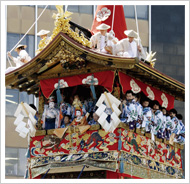 長刀鉾
According to the traditional regulations of the Gion Festival, this float leads the procession of thirty-four floats every year, in spite of the fact that the order of march for the other floats is determined by lots drawn officially by the Mayor of Kyoto in advance. The word “Naginata” means halberd in Japanese, and a symbolic halberd is locasted on its summit. This float is said to have the power to exorcise the evil spirits which cause epidemics due to the operation of this halberd. This is also the only float in which a live child rides. This child is chosen specially every year from among many traditional families in Kyoto to represent the Shinto Deities.
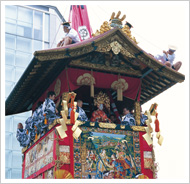 函谷鉾
The decoration on the top of this float is a crescent moon, which symbolizes an ancient Chinese legend about “Kankoku” Barrier.During a civil war in 30 B.C., a lord named “Moshokun” needed to pass through a barrier called “Kankoku” at midnight. Since the rules stated that the barrier had to be opened at the first cock crow morning, the lord mimicked a cock’s crow, and thereby tricked the guards into opening the barrier. Like many other floats, this float displays both Western and Eastern art masterpieces. The Gobelin tapestry hanging on the front portrays a scene from the “Genesis” chapter of the Old Testament, while the one on the back is a Japanese screen with calligraphy by Saint Kobo Daishi (744-835).
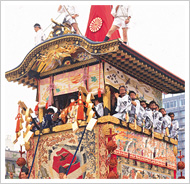 菊水鉾
According to Chinese legend, in the Chou Dynasty, a mysterious child named “Kikujido” (Chrysanthemum boy in Japanese), who lived deep in the mountains by himself, gained eternal youth by drinking the dew from chrysanthemum flowers. Therefore, this float has a life-size doll, symbolizing “Kikujido”, and a symbolic chrysanthemum flower on top. This represents the wish for eternal youth and longevity for everyone.
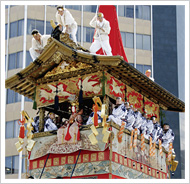 月鉾
The decoration on the top of this float symbolizes a crescent moon. Because the moon has been so admired by the Japanese people for its beauty since ancient times, even now it is often used as a theme in the fine arts, poetry, novels, and music. This float is full of precious fine art treasures, such as the painting on the ceiling by Okyo Maruyama, one of the greatest Japanese painters of the 18th century, and the carvings at the gables by Jingoro Hidari, one of the greatest Japanese sculptors of the 17th century.
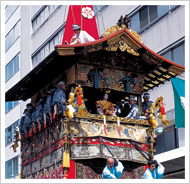 鶏鉾
The triangle with a circle in it at the top of this float symbolizes the birth of a hen (“niwatori” in Japanese) from an egg. Philosophically, it has been said that a triangle and inscribed circle represent the primordial chaos from which the universe, as we know it, emerged in the age of the gods. What has made this float especially famous, however, is the Gobelin tapestry on the back, which depicts a scene from the Trojan War in Greek literature. This masterpiece was made in the 16th century.
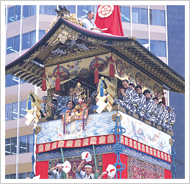 放下鉾
The three disks on the top of this float represent the sun, moon and stars. Hence this float was named “Hoka” (beaming). It is also said that the image of a monk named “Hokaso” enshrined in it is the origin of the name of this float. The celestial child on this float is a life-size puppet.The float, most renowned for its golden lacquer and gorgeous materials was made in 1878.
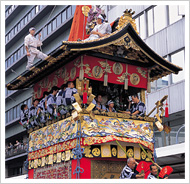 岩戸山
Instead of a halberd, a pine tree towers above this float, which is dedicated to “Amaterasu-omikami,” the sun goddess. The Japanese emperors are said to be descended from her. Iwato means “rock cave” in English. According to Japanese legend, the sun goddess hid inside a cave to show her anger with the other gods, and didn’t come out for a while. During this period, Japan became completely dark without sunshine.
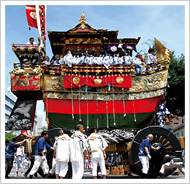 船鉾
This float is built in the shape of an ancient ship. According to a Japanese tale, this ship was used for carrying a Japanese empress named “Jingu Kogo”, who is still worshipped among women as the Goddess of safe delivery. This float is also very popular for its unique style and gorgeous carvings, which are located all over the central portion. The main figures in the float are Empress Jingu Kogo and “Ryujin”, the God of Sea.
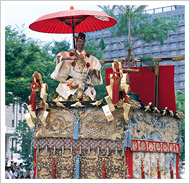 山伏山
“Yamabushi” are Japanese mountain ascetics. According to their beliefs, mountains are the abode of supernatural powers and wisdom, which any man may acquire by practicing austerities for the proper amount of time. The figure on this float is “Jozokisho”, a famous Yamabushi in typical costume: a long white robe, with a hatchet and a rosary in his hands, and a conch shell in his belt.
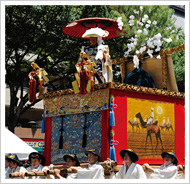 孟宗山
The scene portrayed on this float is derived from an ancient Chinese legend. On a very cloudy, snowy day, the sick mother of Moso, a poor Chinese man, told her son that she wanted to eat some fresh bamboo chutes, which are impossible to get in winter. But this dutiful son dug into the snowy ground, praying to the Gods for mercy. Then the frozen ground suddenly opened, and he found some bamboo chutes there. The design of the tapestries on this float is a very plain and philosophical black and white painting, which is rather unique compared to the very colorful tapestries on the other floats.
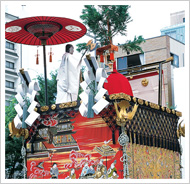 太子山
Taishi means “crown prince” in Japanese. The figure on this float is Shotoku Taishi, the sixth century Japanese prince regent and prodigy, who wrote the first Japanese constitution. Also, it was under his rule that Buddhism was first promulgated and protected by the Japanese Government. On this float, he is entering a forest in order to select the proper wood to cut for the temple which he has decided to build. This float is unique among all the floats, as it had a cedar bough, instead of the usual pine bough.
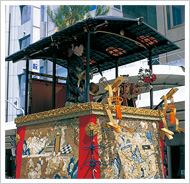 郭巨山
On this float there is a figure of Kakkyo, a poor Chinese man who lived in the third century. He was about to bury his son alive, so that his son’s share of food could be given to Kakkyo’s very old mother. While he was digging in the ground, he found a potful of gold coins, which saved his son’s life and made his whole family rich.The two figures on this float are Kakkyo and his son, who stand happily with a pot of gold coins between them.
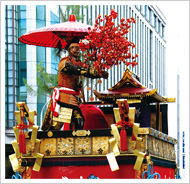 保昌山
This float depicts the story of Fujiwara Yasumasa (Hosho is another way to read his name in Japanese), an 11th century Japanese warrior. He loved a court lady, who entreated him to get some plum blossoms, which were blooming at the Imperial palace. This float is, therefore, worshiped as the God of love, and on the festival eve, people can get a special talisman for a happy marriage in front of this float.
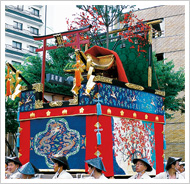 油天神山
This float bears a portable Shinto shrine, named Kitano Tenmangu, which is dedicated to Lord Michizane Sugawara (845-903), an extremely intellectual scholar who served the Emperor. Because he was also one of the three best calligraphers of Japan at that time, children and students still worship at this shrine, and Sugawara is considered the God of education and calligraphy.
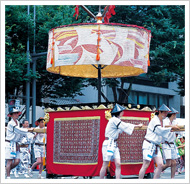 四条傘鉾
This float is a re-creation of one of the original halberd float types. The top of the umbrella is adorned with a pine sapling, and small paper decorations. At the beginning of the Meiji period, once in 1871, Shijokasa Hoko finished participating in the Gion Festival procession. In 1985, the people of the area reconstructed the float. In 1988, Shijokasa Hoko was revived as the last of the 32 floats, after a 117 year absence. The dancing and music accompanying the float are representative of Kyoto during the Muromachi period. The dancing, which is similar to the Kenketo dancing done at the Taki Shrine in Shiga Prefecture, is performed by 8 children.
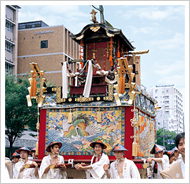 蟷螂山
This float derives its name from an old saying in China that a praying mantis, though small, is courageous enough to raise its ‘hatchets’ high in the air and stand in front of a marching army to try to stop it. The origin of this float dates back to the mid-14th century, when Shijo Takasuke (1292-1352), a high-ranking aristocrat from this neighborhood, courageously fought for a cause and was killed. A rich local merchant named Chin-uirou Tainensouki, who was an immigrant from China, sympathetically associated Shijo Takasuke with the proverbial praying mantis (known as a “Toro” or “Kamakiri” in Japanese), and made a figure of the insect. The praying mantis figure was displayed on a cart owned by the Shijo family, and paraded along with Gion festival floats in 1376, the 25th anniversary of the death of the valorous courtier. The greatest feature of this float is the fact that the praying mantis and the wheels of the mounted court cart are linked to move together mechanically, which is unique among the Gion floats.
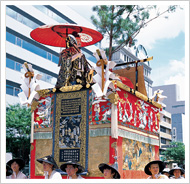 伯牙山
Hakuga was a great koto (oriental harp) master during the Tsin dynasty (280-419) in China. His friend Shoshiki was the only person who truly appreciated his musical virtuosity. When Hakuga heard of Shoshiki’s death, he realized that no one else but Shoshiki could love his music. Thus, he broke his harp with a hatchet in his deep grief. The decorations on the float were primarily imported from China.
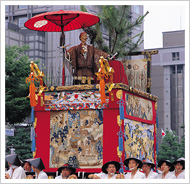 木賊山
This float depicts a scene derived from a very famous Noh play. An old man was cutting his mare’s tails (“tokusa” in Japanese) on a mountain, he happened to meet his son, who had been kidnapped a long time ago. The designs of the gorgeous brocade materials which are used for the costume of the figure were originally introduced from Korea and China.
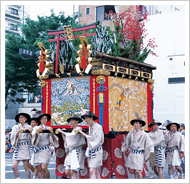 霰天神山
It is said that in 1510, a great fire raged throughout Kyoto. Suddenly, however, hail (“arare” in Japanese) began to fall and put out the fire. Then, at the same time, a small statue of Tenjin, about 3.6 cm. in length, dropped from the sky. From that time onward, Tenjin became popular as a deity of fire protection and hail, as well as a God of education. This float is meant to represent Tenmangu Shrine, and includes a statue of Tenjin in the middle of it. Since Tenmangu Shrines are especially noted for their plum blossoms in February, this float bears both pine boughs and plum blossoms.
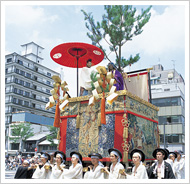 白楽天山
The two figures on this float are Hakurakuten, a famous Tang dynasty poet of ancient China, and Dorin, a high ranking priest of Zen Buddhism. The scene represents these two persons discussing question of Zen. The design of the tapestry hanging on the front of the float was adapted from a story of the Trojan War in Greek literature.
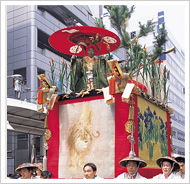 芦刈山
The scene on this float is derived from “Ashikari”, a famous Noh play. A woman who was walking on a lonely beach was reunited with her former husband, who was living a very poor life, cutting reeds on the seashore. The figure is the husband, who has some reeds in one hand, and a sickle in the other. The brocade tapestry on the rear of the float is an ancient Chinese masterpiece.
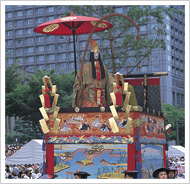 占出山
Urade means “divination” in Japanese. This float depicts an ancient Japanese tale about Empress Jingu Kogo, the Goddess of safe delivery, who went fishing to divine her luck by the amount of fish she caught.The figure of Empress Jingu Kogo on this float holds a fishing line in her left hand, and a fishing pole in her right hand. The design of the embroidery and brocade on each of three sides depicts the three most famous scenic wonders in Japan.
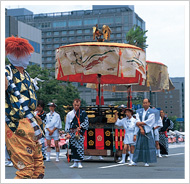 綾傘鉾
This float is a recreation of one of the original halberd float types, and is noted for its enormous rooster-patterned umbrella. Traditionally, it was accompanied by a troupe of dancers wearing god masks. In the Edo Period (1834), the float was rebuilt on a smaller scale with an umbrella on its roof. This, however, was destroyed in the great fire of 1868. From 1879 to 1884, the float participated in the festival parade. It was renovated to its present appearance in 1979. The central figure in today’s dance is a bear carrying a halberd. Music is provided by bells, drums and flutes. The origins of this dance can be traced back to the 18th century, when it was practiced by the people of Mibu-mura.
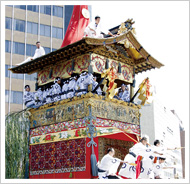 北観音山
Because this float is dedicated to Yoryu Kannon (a merciful goddess) and Idaten (a guardian deity), their figures are on the float. The originals were carved by a famous Buddhist priest, but unfortunately these were destroyed in one of the many fires which have plagued Kyoto throughout its history. The metallic decorations located around the transoms of the float are especially beautiful, and make this float much more gorgeous and magnificent.
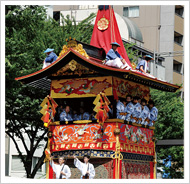 南観音山
According to the traditional regulations of the Gion Festival, every year this float comes last in the procession, just as Naginata Hoko comes first. This float is dedicated to Yoryu Kannon (a merciful goddess), and her image is placed together with a figure of a Saint. These figures are said to protect people from all forms of sickness. Also, the large willow branch which protrudes from the float is believed to chase all sickness away. The decorated ball at each corner of the float represents incense, the symbol of the goddess of medicine.
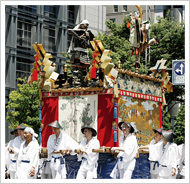 橋弁慶山
The figures on this float depict a very famous story from Japanese history. Benkei, a monk-warrior in armor, and Ushiwakamaru, a young boy in everyday dress, had a fight on the Gojo Bridge in Kyoto. Ushiwakamaru won, despite the fact that Benkei was a very powerful warrior, who had never been defeated by anyone before. The figure of Ushiwakamaru standing on one foot and supporting the rest of his body, is considered to be a masterpiece of design and workmanship. The tapestries were produced during the Ming dynasty in China.
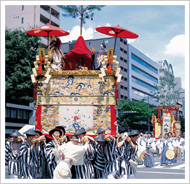 役行者山
This is the only float bearing three different figures . En no Gyoja, who sits in the middle, is a very high ranking ascetic. Hitokoto nushi, who stands on the left, is a man who built a long stone bridge by order of En no Gyoja. The Goddess Katsuragi stands on the right. This scene depicts a Japanese fable. En no Gyoja gained his power through his severe ascetic practices, and he could control both gods and human beings.
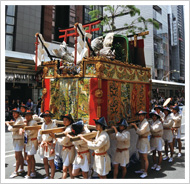 鯉山
The theme of this float comes from a Chinese legend that if a carp (koi in Japanese) could swim up ryumon (a waterfall), it would become a dragon. The figure of the carp on this float is quite realistic, vivid and beautiful, as if a living carp is jumping up the waterfall. The shrine on this float is dedicated to Susano-o no Mikoto”, a powerful deity in Japanese mythology. The designs of most of the tapestries describe stories of the Trojan War in Greek literature. They were produced in the 16th century in Brussels, Belgium.
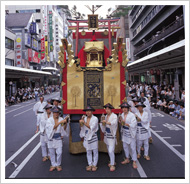 八幡山
The object of worship of the small Shinto shrine which located on this float is Hachiman, one of the most famous Japanese gods. The miniature shrine on the float is decorated with gold foil, and it is said to have been made in the Tenmei period, between 1781 and 1788.
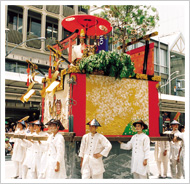 鈴鹿山
According to a Japanese legend, a demon threatened the peaceful life of a small village by attacking its inhabitants and passing travelers every night. The Goddess Suzuka, to whom this float is dedicated, encountered and defeated this demon. The Goddess Suzuka has a halberd in her left hand. She is dressed in female attire and capped by a gold hat, and is, therefore, said to protect travelers from robberies and harm.
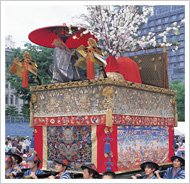 黒主山
The figure on this float is Otomo no Kuronushi, an outstanding tenth century Japanese poet. The scene depicts this poet looking up at the beautiful cherry blossoms. The railing decorations on this float are made of metal in the shape of cherry, peony, chrysanthemum flowers and maple leaves, signifying the four seasons. According to Japanese legend, if one puts cherry blossoms from this float on the front door, evil can never get into the house.
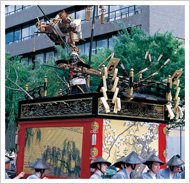 浄妙山
The scene on this float depicts the story of a famous battle that occurred in the 12th century, between the Heike and Genji clans, at the Uji River near Kyoto. Ichirai, a monk warrior, jumped over his fellow monk warrior Jomyo to rush headfirst into the enemy ranks. The figure of Ichirai jumping in the air is supported by a wooden wedge.
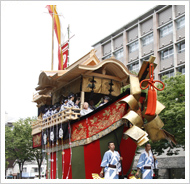 大船鉾
ŌFUNE HOKO performed the role of the final position in the procession of the last festival, exempted from the lottery, called Gaisen Funehoko‐returning in triumph, while FUNE HOKO in the first festival called Shutsujin Funehoko‐going into battle. The float has its origin more than 500 years ago. It has been absent from the procession since losing its house frame, wooden structure, wheels and so forth in the Hamaguri Gomon Incident in 1864, although it had been revived several times against suffering from the big fires through the Edo period.After passing many years, in 1997, hayashi - the float orchestra revived and Ōfune Hoko resumed as “Imatsuri”, not joining the procession, displaying with the figure of Empress Jingū which had escaped from the fire, the big gold strips decorating at the bow, and the great steering wheel, mizuhiki, maekake, ushirokake and others produced by using high technique of fabric and embroidery. That brought a great opportunity for revival. In 2012 Ōfune Hoko “Karabitsu” style procession began, and finally in 2014, with the enthusiasm of Shijo-cho residents and the support of many people, it joined the procession after 150 years’ absence.
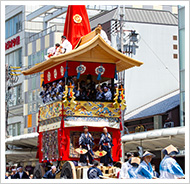 鷹山
The Taka-yama float has been a participant in the Yamahoko float procession at Gion Matsuri for most of its history since ancient times. The description of this float, with the name Taka-tsukai-yama, appears in a document from the 15th century, indicating the long history that it boasts. Originally, the float was carried on people’s shoulders during the procession. Then, during the Edo period, large wheels were attached to it so that it could be towed. The float was once ravaged by the massive fire that burnt Kyoto down in 1788, but was reconstructed with a magnificent large roof at the end of the 18th century. However, at the beginning of the 19th century, it was wrecked once again, this time due to a great storm disaster. Since then, Taka-yama has not been able to participate in the float procession. To make things worse, almost all of the float parts were destroyed in a fire caused by a civil conflict that broke out in 1864. On this occasion, however, the three dolls that had been displayed in Taka-yama over generations—Taka-jo, Inu-kai and Taru-oi—escaped damage. Residents of the district housing Taka-yama have since participated in the festival by displaying these dolls at the procession eve called Yoiyama. However, in 2019 they resumed their participation, just carrying “karabitsu,” a sacred chest with a hanging scroll that has the name of a deity of Yasaka Shrine written on it. In 2022 Taka Yama has been able to come back to the procession with its fully decorated float for the first time in 196 years.
* Karabitsu: a box that contains sacred items associated with Taka-yama